Digital Transformation Solutions

End-to-End Solutions
from Consulting to System Development

Custom AI & Automation Systems for AEC and Plant Engineering

We transform complex engineering workflows into intelligent, scalable digital operations.

Discuss Your Automation Project with an Expert
Strength of Arent

AI × BIM × Automation for Construction

Arent combines advanced 3D engineering, AI, and mathematical optimization to turn BIM into an intelligent platform for automation.

Backed by extensive experience with leading enterprises, we bring deep AEC and plant domain expertise to deliver practical solutions that accelerate construction DX.

Deep Domain Expertise Across AEC & Plant Industries

Built through real-world enterprise projects

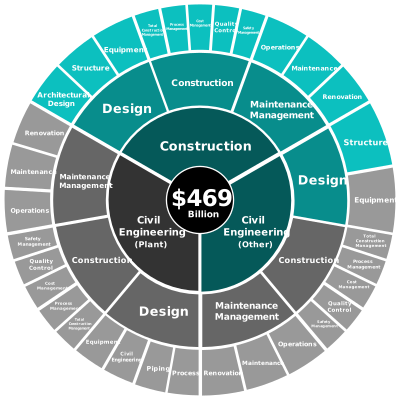
Deep Domain Expertise Across AEC & Plant Industries

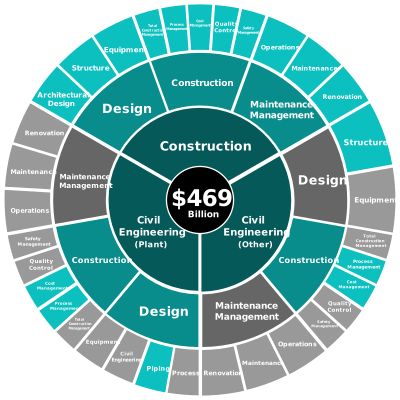
Highlighted areas show domains where Arent has delivered products or solutions

Engineering Excellence Behind Our Technology

Advanced BIM & IFC Expertise

Over 10 internationally certified buildingSMART professionals driving openBIM integration.

3D & Mathematical Engineering Excellence

Strong capabilities in computational geometry and optimization algorithms.

USE CASE

Our Approach

AI-Powered BIM Integration for Engineering Systems

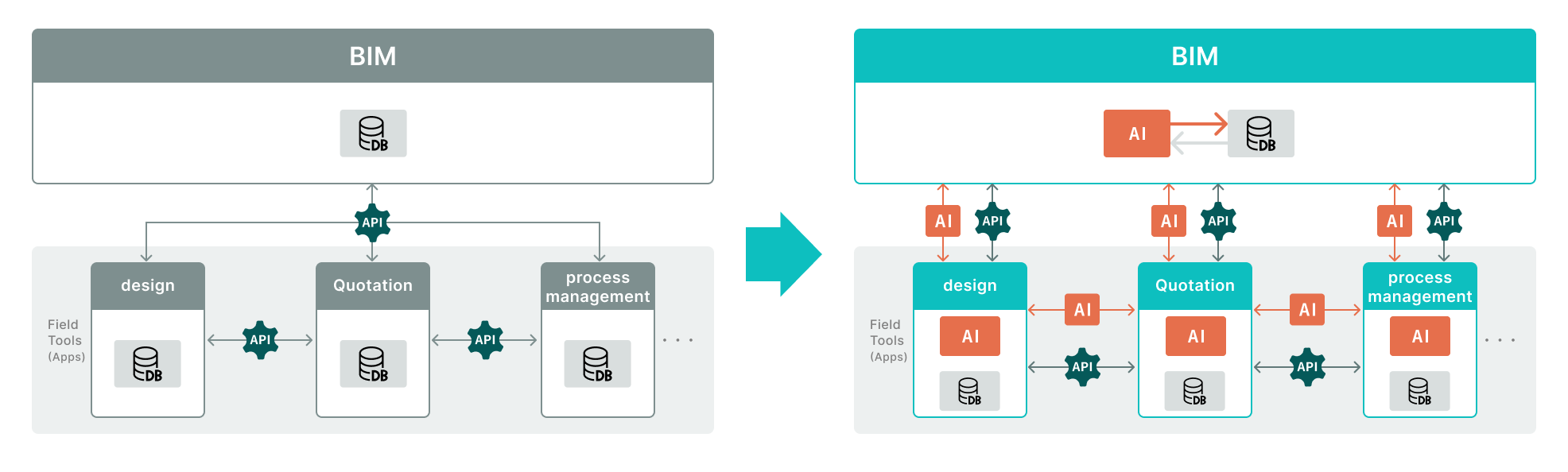
Modern engineering organizations rely on multiple SaaS tools across design, estimation, and project management.
At Arent, we connect these systems using AI and APIs, and develop BIM-integrated automation SaaS, creating a core platform that streamlines workflows across the entire engineering process.

AI-Driven Automation with BIM Data

Application Integration Model with AI — Before and After BIM Integration

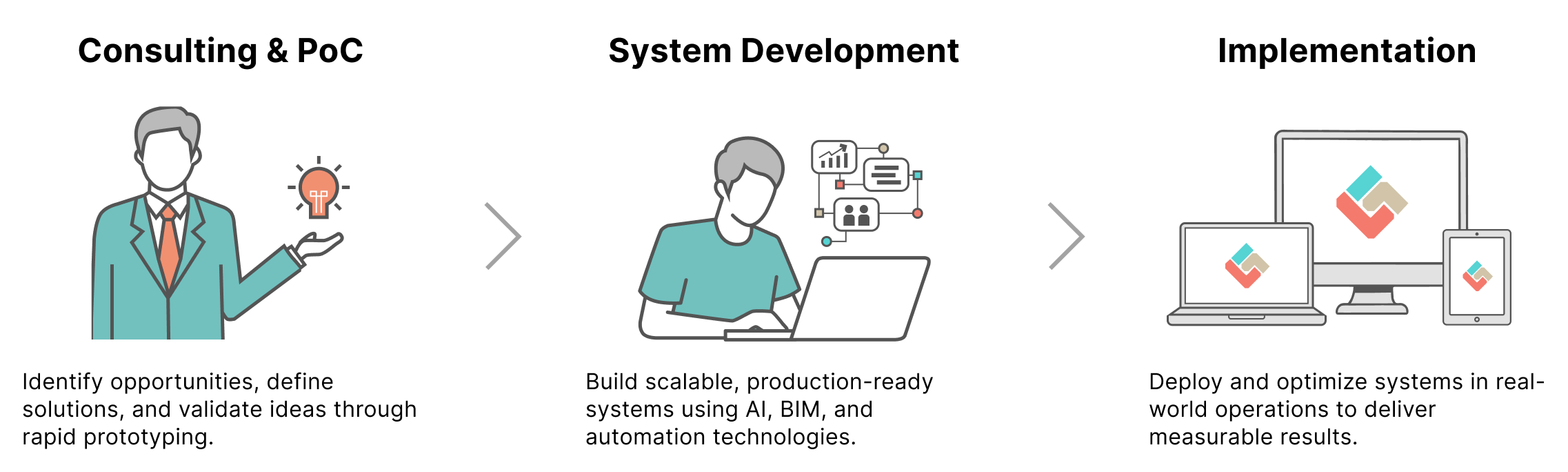
End-to-End Support: From Consulting to Implementation

Arent works alongside clients from strategy and proof of concept to full-scale development and implementation.

By unlocking industry expertise and tacit knowledge, we co-create practical digital systems that solve complex operational challenges and drive real DX in the construction industry.

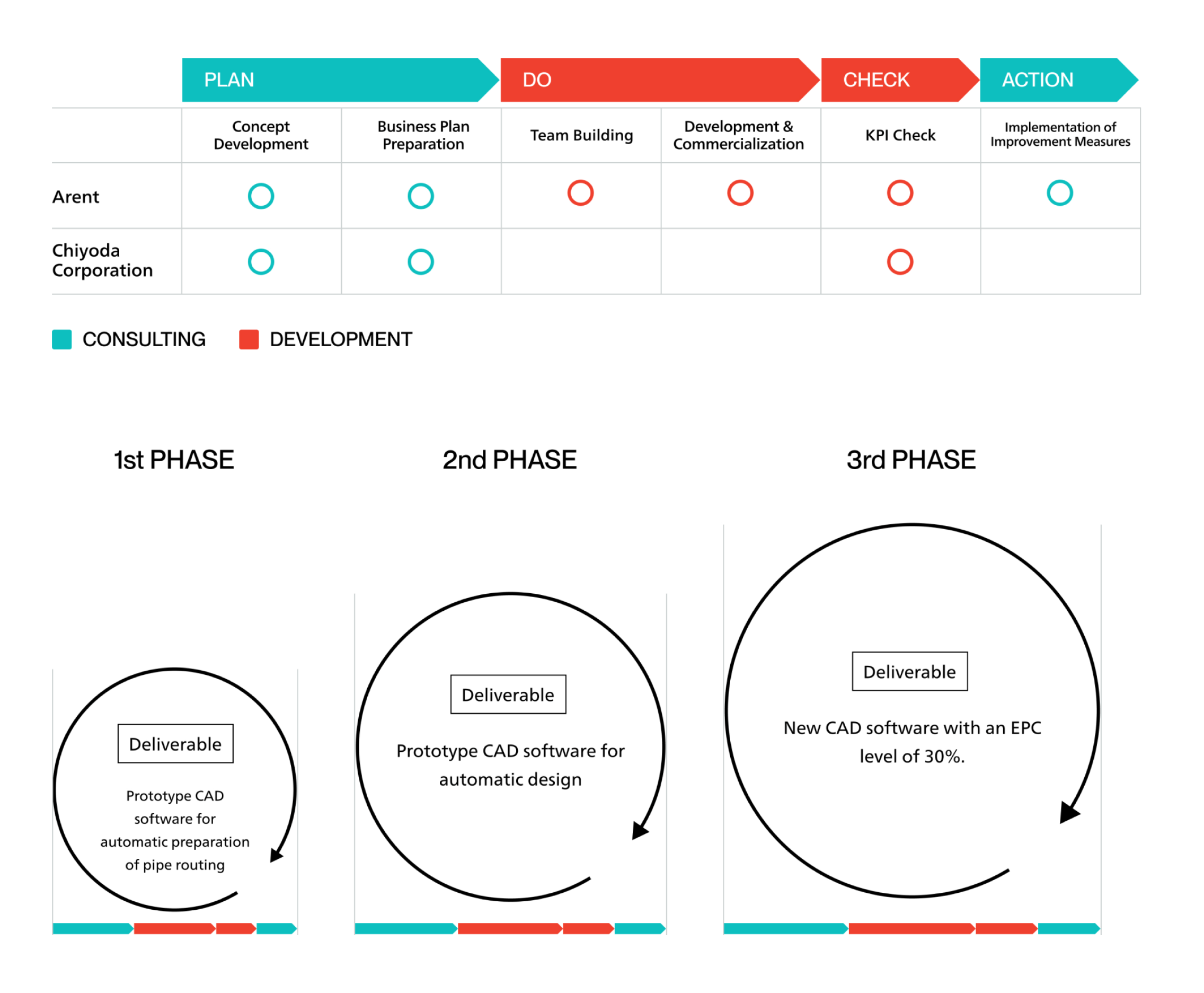
Arent DX Business Creation — Consulting and POC, Main Development, Business Launch
Case Study 01

PLANETS

A BIM-Centric SaaS Platform for Integrated Automation

Arent × Takasago Thermal Engineering

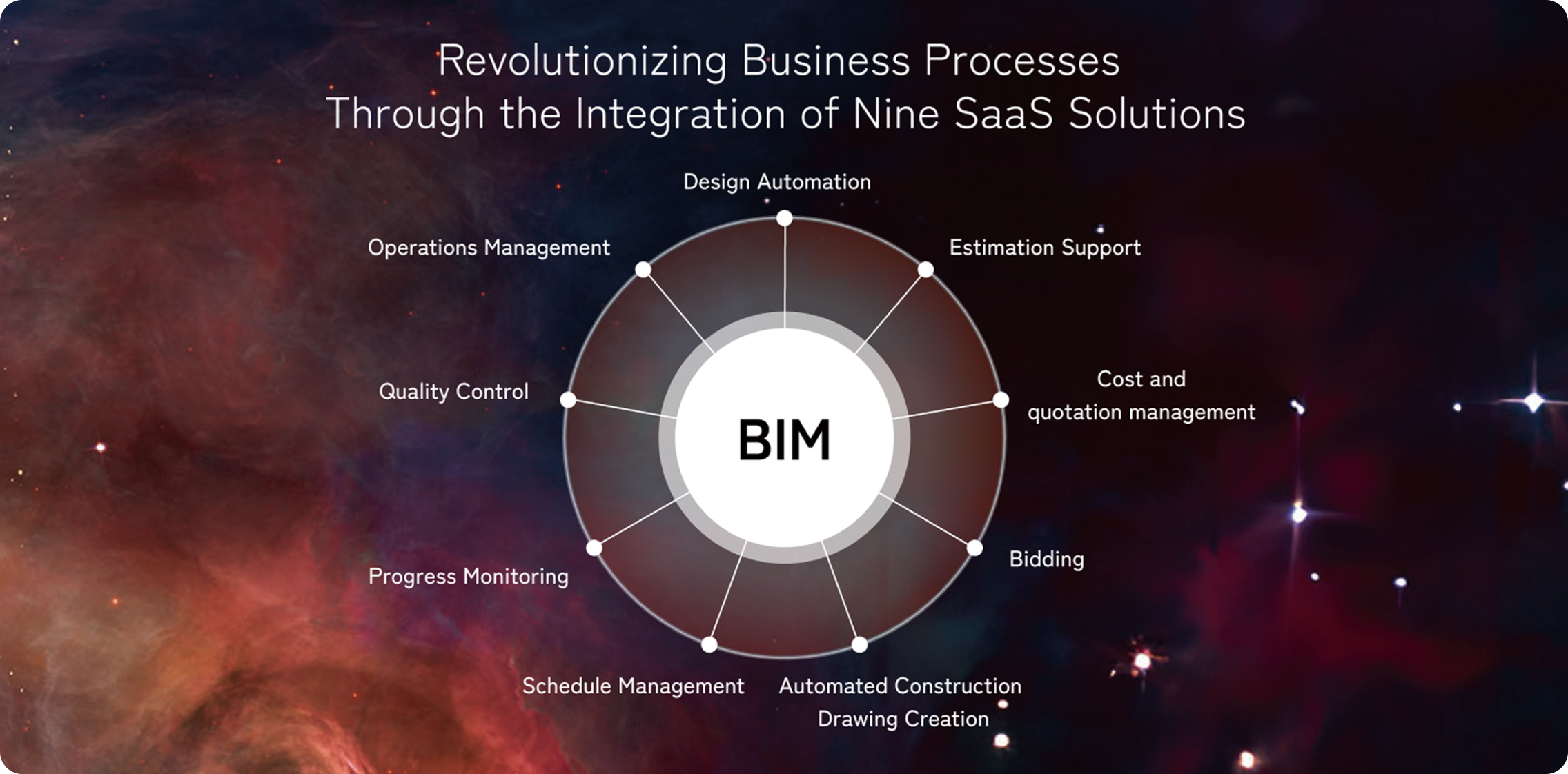
A BIM-Centric Platform Integrating Nine SaaS Solutions for Construction Workflows

PLANETS is a BIM-centric, integrated SaaS platform developed to transform the entire construction workflow from design through operations by leveraging BIM as the core data infrastructure. It is composed of nine interconnected SaaS solutions that digitize and unify previously siloed processes such as design automation, estimation, procurement, construction management, quality control, and facility operations.

The platform was developed through a joint initiative between Arent and Takasago Thermal Engineering, Japan's leading HVAC engineering company. The goal was to modernize the construction process and address industry challenges including labor shortages, reliance on tacit expertise, fragmented workflows, and low overall productivity by harnessing BIM and automation technologies.

Challenge
BIM has not been effectively utilized. Productivity remains low.
Solution
Revolutionize business processes with BIM and automation technologies.

Chart: Domains in the Construction Market

Domains in the Construction Market

Revolutionize Business Processes with Nine SaaS Clusters

By combining BIM and automation technologies, we achieve overwhelming improvements in productivity.

Nine SaaS Clusters

The Culmination of a Century of Knowledge at Takasago Thermal Engineering

PLANETS is not just about digitizing building data, storing, and centrally managing it through BIM; it goes beyond the digitization of business processes using these data. The nine SaaS solutions are a systematization of the deep industry knowledge that Takasago Thermal Engineering has accumulated over many years.

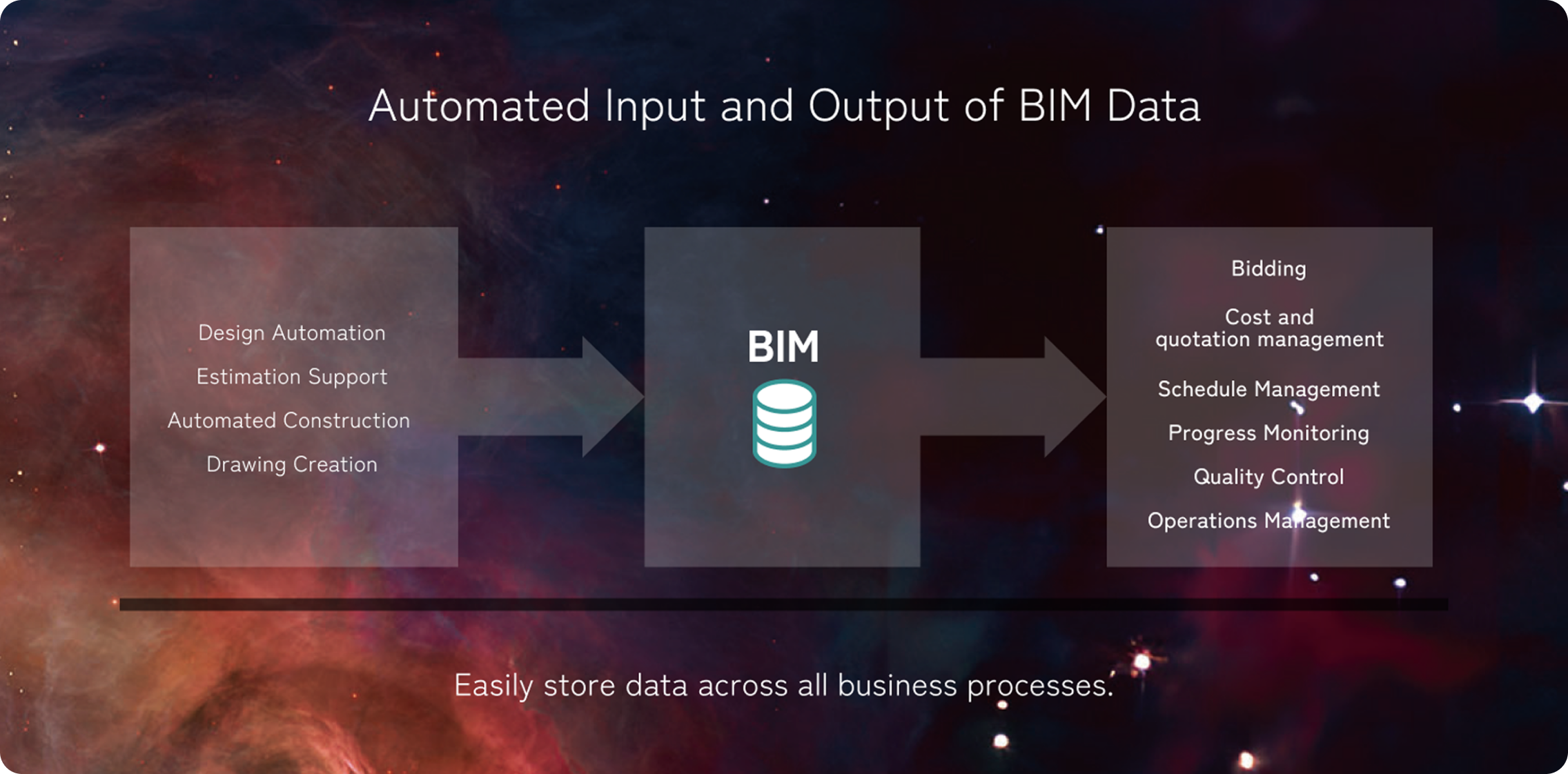
Automated Input and Output of BIM Data

Challenge & Project Significance

BIM has not been effectively utilized in the construction industry, leaving many workflows fragmented and limiting productivity improvements. In response to this challenge, Arent collaborated closely with Takasago Thermal Engineering from the conceptual stage, translating decades of field expertise into a structured digital platform centered around BIM.

PLANETS is designed to unify and digitize previously fragmented processes across construction and facility management. It demonstrates Arent's co-creation approach—turning deep industry expertise into an integrated digital platform tailored to a client's operational environment and built on BIM and automation technologies.

The Platform

PLANETS integrates nine SaaS systems across the construction lifecycle with BIM as its core data infrastructure.
Rather than simply storing BIM data, the platform utilizes BIM to automate and connect workflows across:

  • Design automation
  • Estimation and cost management
  • Procurement and inquiry
  • Construction drawing creation
  • Schedule and progress management
  • Quality control
  • Operations management

This interconnected approach enables structured data utilization across project phases and reduces manual coordination between departments.

Key Capabilities

Design Automation

Automatically converts the entire design process — from basic to detailed design — into BIM, linking design data directly to cost estimation and construction drawing creation to reduce communication costs and enable front-loading.

Estimation Support

Extracts construction material quantities from design BIM and generates estimation BIM even from 2D drawings, enabling its use as initial construction data and supporting schedule creation during the estimation phase.

Estimation & Cost Management

Generates accurate and rapid cost estimates using structured BIM quantity data, historical records, and current market pricing for detailed cost analysis.

Inquiry

Standardizes and visualizes the estimation process to reduce reliance on individual expertise, while enabling structured bid comparison and real-time cost synchronization.

Construction Drawing Automation

Automatically creates non-interfering duct and piping routes by converting drafting expertise into algorithms, reducing rework and improving constructability.

Schedule Management

Automatically generates master schedules from construction BIM data and workload information, enabling centralized and collaborative schedule control.

Progress Management

Tracks construction progress directly within BIM using project system integration and 360° images, with issues linked to quality management.

Quality Management

Identifies inspection targets from BIM and automatically generates documentation to improve inspection efficiency and quality control.

Operations Management

Transfers completed BIM data into facility management, enabling efficient asset tracking, maintenance planning, and long-term operational optimization.

Case Study 02

PlantStream

Automated 3D CAD for Plant Engineering

Arent × Chiyoda Corporation

Design 1,000 Piping Routes in Just One Minute

PlantStream began as a joint development initiative between Arent and Chiyoda Corporation, one of Japan's leading EPC companies.
The objective was to solve long-standing inefficiencies in plant layout design, where piping routing and 3D modeling required extensive manual effort and relied heavily on experienced engineers.

Challenge
Designers have been overburdened.
Solution
CAD takes care of the tremendous amount of work for them.
Challenge
Delays in the design process lead to longer construction period and increased cost.
Solution
With the autonomous design with CAD, the basic design can be prepared in just a few tens of seconds.

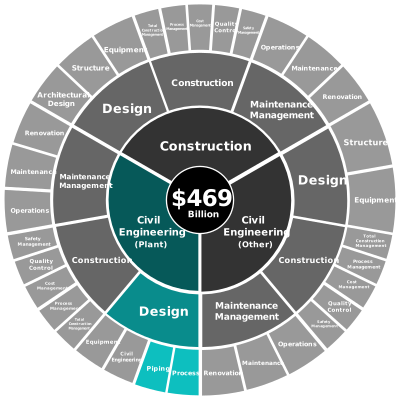
Chart: Domains in the Construction Market

Domains in the Construction Market

The Solution

PlantStream is an advanced 3D CAD platform that automates complex plant piping layout using intelligent, rule-based routing algorithms. By converting expert engineering know-how into software logic, it dramatically reduces manual design effort and accelerates layout planning.

Key Capabilities

Intelligent High-Speed Auto-Routing

Generates optimized piping routes based on engineering rules and constraints, delivering up to 1,000 routing patterns per minute.

Interference-Free Layout Generation

Detects and avoids clashes while maintaining constructability.

High-Speed 3D Computation

Evaluates thousands of routing patterns in minutes.

Rule-Based Engineering Logic

Encodes tacit design expertise into repeatable algorithms.

Rapid Layout Iteration

Enables quick comparison of multiple layout scenarios in early-stage design.

Improved Design Consistency

Reduces reliance on individual experience and standardizes design quality.

From Development to Commercialization

Arent worked alongside Chiyoda from the conceptual stage, systematizing tacit plant engineering knowledge into rule-based algorithms and developing an autonomous 3D CAD solution.

The project was driven by an agile development approach, rapidly building prototypes in short cycles and continuously refining the system through iterative PDCA (Plan–Do–Check–Act) processes. This allowed early validation in real engineering environments and steady performance improvement.

Beyond system development, Arent provided end-to-end business creation support — including product architecture design, implementation, refinement through iterative development, and commercialization strategy.
Through this co-creation model, what started as an internal efficiency tool evolved into a market-ready digital product.

PlantStream Development Workflow

Global Expansion

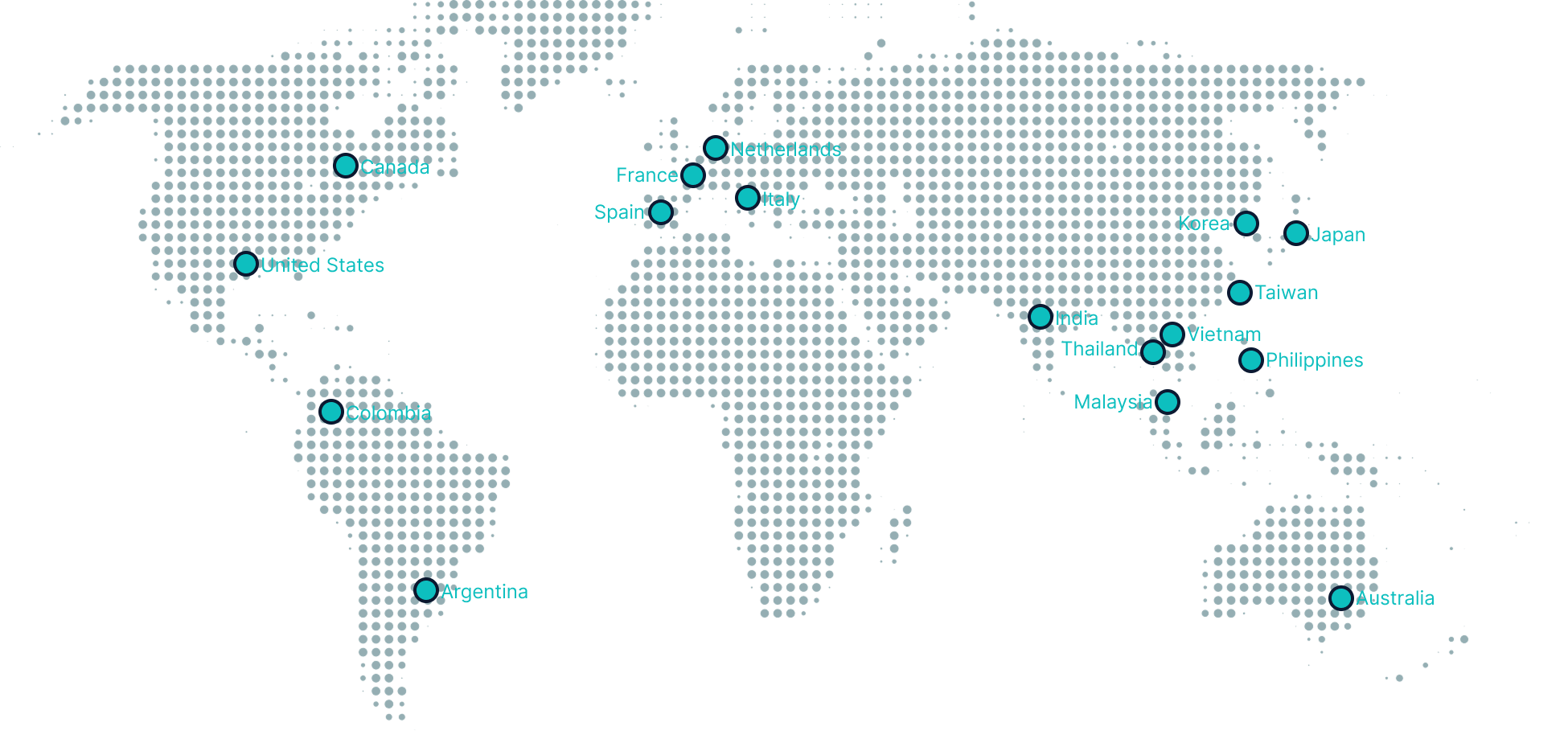
Following successful implementation, PlantStream expanded beyond internal use and is now adopted by plant owners and EPC contractors worldwide.

This case exemplifies Arent's DX Business approach — transforming industry-specific expertise into scalable digital products and supporting clients from development through global market deployment.

PlantStream Solution Map
Special Interview

Revolutionizing plant design. Working as one team.

Arent Inc.

Representative Directors : Kamobayashi Hiroki

PlantStream Inc.

Representative Directors *As of the 2021 interview : Narue Seitaro

Read the Interview
Special Interview
Case Study 03

Platform-Based DfMA

From Requirements to Automated Design

Platform-Based DfMA
Arent — Construction Optimization

AI-Driven Construction Optimization through DFMA Principles

By applying Design for Manufacture & Assembly principles to construction workflows, we dramatically reduce material waste, improve constructability, and accelerate delivery timelines through AI-powered optimization.

Discuss Your Automation Project with an Expert

Platform-based DfMA

DFMA Before After

Project Overview

This project proposes a platform-based DfMA (Design for Manufacturing and Assembly) approach that connects requirements (EIR/AIR) directly to automated design, manufacturing, construction, and operations.

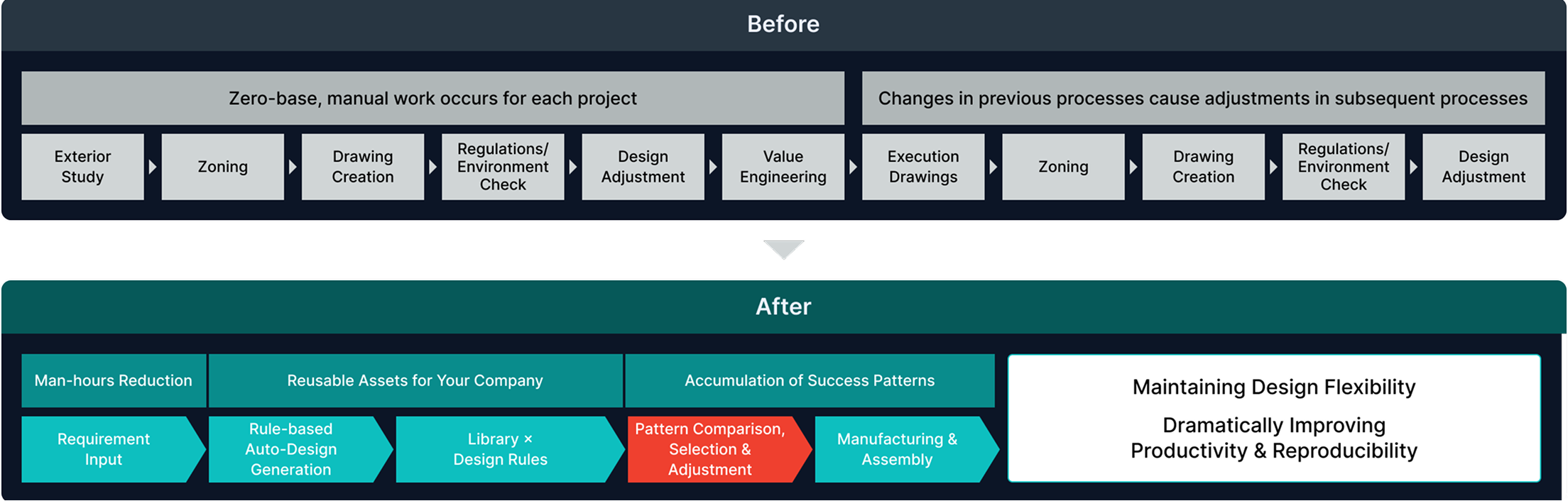
Traditional architectural projects often suffer from zero-based design, repeated manual adjustments, siloed workflows, and limited reusability. Each project requires reworking drawings, coordination, and procurement from scratch, resulting in inefficiency and dependency on individual expertise.

The platform-based DfMA model addresses these structural challenges by utilizing predefined design rules and standardized component libraries to dramatically improve productivity and reproducibility while maintaining design flexibility.

From Requirements to Automated Modeling

At the core of the platform is the Design Capsule concept.

By inputting performance and usage requirements at different scales — Site, Zone, and Asset — the system automatically generates abstract BIM models aligned with EIR/AIR requirements.

Predefined design rules and standardized object libraries are applied to:

  • Filter appropriate capsules based on performance conditions
  • Automatically place and configure spatial units
  • Match capsules with object libraries
  • Generate final Revit models

This enables instant transformation from requirement input to BIM model generation, accelerating early-stage design and consensus building.

The Platform

The platform integrates:

  • Design Rules
  • Capsule Library
  • Object Library
  • Requirement Input (EIR/AIR)
  • Revit + Web Application Integration

Rather than starting from scratch for every project, reusable rules and component libraries become corporate assets. Successful design patterns accumulate and evolve over time, enabling exponential improvement in operational efficiency.

Key Capabilities

Automatic BIM Generation

Generates BIM models automatically from structured EIR/AIR requirements.

Capsule-Based Filtering & Matching

Filters and selects optimal spatial units from libraries based on defined performance conditions.

Rule-Based Layout Generation

Applies geometric, adjacency, service, and regulatory constraints to generate compliant layouts.

Multi-Scenario Evaluation

Produces multiple design alternatives (efficiency-focused, comfort-focused, cost-focused) for comparison.

Quantitative Scoring

Scores design options based on cost, schedule, operational efficiency, carbon impact, and regulatory compliance.

Reusable Design Assets

Converts design rules and modules into reusable organizational assets.

Digital Thread Integration

Connects design, procurement, manufacturing, construction, and operations through structured data flow.

Platform-Based DfMA Approach

Unlike conventional one-off design or rigid modular systems, the platform-based approach:

  • Balances design flexibility with QCD (Quality, Cost, Delivery) stability
  • Enables reuse of shared components and rules across projects
  • Integrates manufacturing and construction considerations from the design stage
  • Supports continuous feedback from construction and operations back into future design

This creates a circular, data-driven project model, where knowledge from procurement, construction, and facility management informs and improves subsequent designs.

Project Significance

This initiative represents a shift:

  • From project-based optimization to platform-based optimization
  • From siloed workflows to integrated digital collaboration
  • From manual adjustment to automated rule-based design
  • From one-off deliverables to reusable digital assets

By structuring tacit knowledge into design rules and standardized components, the platform enables both creativity and industrialized productivity — achieving flexibility, efficiency, and reusability simultaneously.

Ready to Discuss
Your Project?

Let's explore how we can turn your engineering expertise and business challenges into scalable digital systems through AI and automation.